Maruha Nichiro's Relationship with Natural Capital—What We Saw from the TNFD Disclosure—
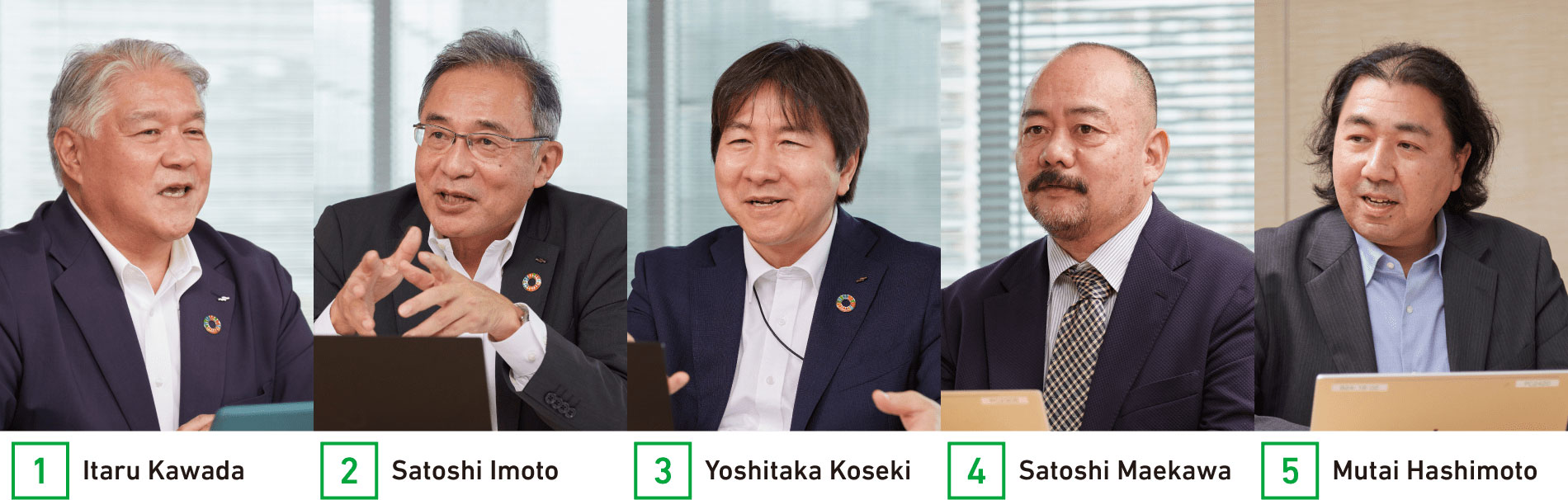
- 1Itaru Kawada
- Maruha Nichiro Corporation
- Managing Executive Officer
- Marine Resources Segment Director, North America Unit Director
- 2Satoshi Imoto
- Maruha Nichiro Corporation
- Executive Officer
- Aquaculture Unit Director
- 3Yoshitaka Koseki
- Maruha Nichiro Corporation
- Managing Executive Officer
- Corporate Division Deputy Division Director
- 4Satoshi Maekawa
- Lead, Oceans and Fisheries Group, First Nature Conservation Division
- WWF Japan (World Wide Fund for Nature Japan)
- Promotes and helps obtain seafood eco-labels.
Member of the Council for Promotion of the Industrialization of Aquaculture Growth. - 5Mutai Hashimoto
- Lead, Sustainable Finance Group, First Nature Conservation Division
- WWF Japan (World Wide Fund for Nature Japan)
- Master’s in Environmental Management, The University of Nottingham, UK.
Has been in his current position since July 2021.
The Maruha Nichiro Group began considering disclosure based on the TNFD Framework*1 in FY2024, and in FY2025, it conducted an analysis of dependencies and impacts based on the LEAP Approach*2, which is the guidance advocated by TNFD. This time, we exchanged opinions with external experts who have specialized knowledge and broad insight into Maruha Nichiro's issues and initiatives for biodiversity and natural capital, as well as the future, which have been revealed through TNFD disclosures.
- *1
- TNFD (Taskforce on Nature-related Financial Disclosures): An international framework for companies and financial institutions to assess and disclose risks and opportunities related to natural capital and biodiversity.
- *2
- LEAP Approach: Developed by TNFD as an integrated analytical method for assessing nature-related issues, including nature contacts, nature dependencies, impacts, risks, and opportunities. The LEAP approach involves scoping and then taking the steps of Locate, Evaluate, Assess, and Prepare to prepare for TNFD disclosure.
Based on the TNFD Framework, We Conducted Surveys and Analyses on the Wild Fish Pollock and Tuna, Yellowtail, and Amberjack Farmed in Japan
-
- Koseki:
- We believe that the raison d'être of a company is to promote the improvement of the three values of economic, environmental, and social value in a trinity, and that the company itself is sustainable. The Maruha Nichiro Group relies heavily on natural capital for its corporate activities, handling approximately 1.7 million tons of fish annually and aquaculture, of which approximately 1.36 million tons are natural marine resources. It is of utmost importance to manage natural capital and make it sustainable for consumers and the global environment into the future. The organization that plans and manages the progress of various sustainability-related initiatives has been promoted to a department as the Sustainability Strategy Department, and the Sustainability Committee has been held four times a year since two years ago, with executive officers with all positions participating in deepening discussions.
- Under these circumstances, we began identifying materiality in stages from around 2021, and clearly narrowed down the materiality to nine between 2022 and 2024 in the previous medium-term management plan. Based on both internal and external perspectives, we selected nine materialities based on mapping from the perspective of importance and impact and set KGI and KPIs for these nine in the previous medium-term management plan. In addition to pursuing economic value in the medium-term plan, we have also increased our awareness of TNFD as we pursue progress towards materiality. Initiatives based on the TNFD framework began in 2023. In 2024, we worked on Locate and Evaluate as the entrance to the LEAP approach, and in 2025 we moved on to Access and Prepare, leading to the current disclosure of information. First, we proceeded with the first and second evaluations at ENCORE*3, but since we handle a very wide range of fish species, we thought it was unrealistic to evaluate all species all at once, so we evaluated pollock in Alaska, which has been working on for nearly 50 years, with a large amount of wild fish handled. Regarding aquaculture, we conducted an evaluation because we thought it was necessary to look at the impact on the environment and society of marine aquaculture, especially tuna, yellowtail, and amberjack, which are carried out in Japan.
- *3ENCORE: An acronym for "Exploring Natural Capital Opportunities, Risks and Exposure", which helps organizations investigate their exposure to nature-related risks and understand their dependence on and impacts on nature. Line tool.
-

- Hashimoto:
- We feel very encouraging that you are working from the perspective of what is important not only for your company but also for the global environment. Since the TNFD had been working on fishery resources and human rights issues even before it published its recommendations, I think the TNFD was a framework that was easy to disclose.
- While it is difficult to cover all of TNFD disclosures, I think it would be appropriate as one approach to select and disclose some fish species such as pollock, which is the largest volume of wild fish, and to work on it from what your company is thinking concretely.
- On the other hand, I had the impression that a disclosure that better conveyed thoughts on environmental and social issues that were not subject to this disclosure would be worth reading as a reader.
What We Have Seen from the LEAP Approach.
Greater Impact Across the Value Chain
-
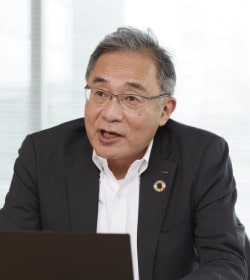
- Kawada:
- First, I would like to talk about the North American unit. In the previous medium-term plan, we used to describe it as an overseas unit, but this time the name of the new unit is in the form of "North American unit". Our pollock business has two businesses: we have our own factory in Alaska, USA, and we are engaged in fishing, manufacturing, processing, and sales, and we purchase pollock products from the Sea of Okhotsk coast on the west coast of the Kamchatka Peninsula and import and sell them to Japan. As a result of analyzing the fishing areas in both areas, we have selected them as priority areas because they are ecologically and biologically important, are protected areas for toad and seals, are protected areas including national parks in each country, and are operated in adjacent areas.
- Next, we diagnosed the pollock business from the perspective of the degree of dependence and impact on biodiversity. As a result of conducting research on the dependence and impact of ENCORE analysis, as well as papers and other research, it was found that pollock resources are very dependent on spawning, growth, and growth location, as well as the marine environment surrounding them and water quality. In addition, it was found that if pollock fishing methods and fishing gear are not properly operated and managed, it will have a very significant impact on the ecosystem of not only pollock but also other organisms. We recognize that it also has a significant impact on the human rights of local residents, including local fishermen and business workers.
- In addition, we examined the possible risks and opportunities of the pollock business's dependence on and impact on natural capital. We used two types of scenarios to analyze based on the degree of degradation of nature and ecosystems and the spread of sustainability-related markets. "Scenario 1" is that the deterioration of nature and ecosystems is small and the sustainable market is expanding, and "Scenario 3" is the exact opposite, in which the deterioration of nature and ecosystems progresses and the sustainability market does not expand. Based on the two scenarios, including risks such as the amount of pollock resources, the impact on the ecosystem, and the human rights of business workers and local residents, the risk intensity is low in "Scenario 1" and the financial impact is small, while in "Scenario 3", the impact on pollock fishing is large, and the negative impact is considered to be very large financially. On the other hand, in terms of opportunities, Scenario 3 cannot appeal to strict resource management as an advantage, but in Scenario 1, the expansion of the sustainability market will increase the value of sustainable and stable product supply through strict resource management businesses, and the positive financial impact will be greater.
- Based on the results of these scenario analyses, we recognize that it is very important to operate in accordance with Alaska's strict fishing regulations and maintain sustainable MSC*4 certification as a risk reduction measure. Building good communication with local business partners and stakeholders is essential for stable operations, and it is very important to use local tax payments as financial support to improve the living conditions, education, and livelihoods of local residents living in extremely cold regions (CDQ Program/Alaska Coastal Community Development Allocation).
- In order to maximize opportunities, our KPI is to make more than 15% of sales of marine products and products including marine products GSSI*5 certified products such as MSC by 2030. Although differentiated sales of GSSI-certified products are not widespread in Japan, we believe that our mission is to build a society that is differentiated in the Japan market as well as in Europe and the United States, and that sustainably utilizes marine resources while maintaining biodiversity.
-
- Imoto:
- Of the 13 aquaculture units in operation in 2024, 11 sites other than Saeki City, Oita Prefecture and Kagoshima City, Kagoshima Prefecture have been confirmed to fall under the category of highly important sea areas from the perspective of biodiversity designated by the Ministry of the Environment, and have been identified as priority areas. In recent years, new fish farms have been set up in Nagato City in Yamaguchi Prefecture and Numazu City in Shizuoka Prefecture, and are currently operating at 15 bases. Second, we recognize that the cultivation of farmed fish is highly dependent on the water quality and environment of the fishing grounds. Similarly, we will develop our aquaculture business with consideration for the impact not only on the surrounding marine environment and ecosystem, but also on the lives of people in the areas where we operate.
- Next, we examined the degree of dependence on natural capital and the degree of impact on the environment, and what risks and opportunities could be present. In terms of risk, the degradation of nature and ecosystems has already begun, and further progress is expected in the future. It is difficult to secure stable aquaculture food due to the depletion of natural marine products, and there is also a risk that the breeding environment will deteriorate due to rapid environmental changes and rising water temperatures due to global warming. Currently, it cannot be said that sustainable products are penetrating the market in the Japan market, but there is a possibility that sustainable products will be accepted rapidly, and we see this as an opportunity. Based on these factors, we believe that "Scenario 2" and "Scenario 3" are highly likely, and that they will have a significant financial impact on the aquaculture business.
- In Scenario 2, we believe that the acceptance of sustainable products, the expansion of the market, and the ability to secure sustainable products and alternative protein ingredients will lead to differentiation from other companies and emphasize the superiority of our aquaculture business.
- As a measure to respond to the risks and opportunities identified at the end, we have obtained ASC*6 certification for environmentally friendly feeds, including the use of managed feed, and we are managing fishing grounds that do not have certification standards based on ASC certification standards. In addition, we are now starting to effectively use residues from seafood processing plants for feed as a countermeasure against soaring feed prices. In the future, we will also consider the use of insects. In order to ensure the sound operation of the fish farm, we do not miss the harmony with the local people and promote local employment. We will continue to actively participate in local events and communicate with local people so that they feel that our business is indispensable to the local community.
- Getting along well with the local people while maintaining such communication is the most important thing in the aquaculture business, and I would like to do this well. In order to maximize this opportunity, we would like to actively sell sustainable certified products in the B-to-B market, such as eating out and ready-made meals. Furthermore, in the future, I would like to promote research and development of things like bio-meat. I imagine that in 100 years, there will be no more farming, and there will come a time when you can press a button to catch tuna or amberjack. It will take time, but I would like to prepare various things to maximize future business opportunities.
- *4MSC (Marine Stewardship Council) certification: An international certification system to promote sustainable fisheries. Sustainable seafood caught in fisheries that meet MSC's strict standards will be awarded the MSC "Ocean Eco Label".
- *5GSSI: Global Sustainable Seafood Initiative, which stands for Global Seafood Sustainability Initiative, checks a number of certification schemes in line with FAO's guideline "Code of Conduct for Responsible Fisheries".
- *6ASC (Aquaculture Stewardship Council) certification: An international certification system given to responsible aquaculture industries that are environmentally and socially conscious.
The four pillars of the system are (1) compliance with laws and regulations and appropriate management, (2) responsibility for environmental conservation, (3) respect for human rights, and (4) animal welfare. Certified seafood can be labeled with the ASC eco-label.
-
- Maekawa:
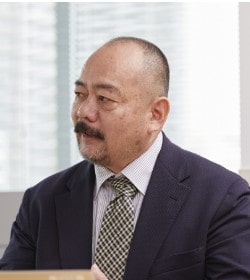
- Regarding pollock, I think there are few risks in Alaska because fisheries management has been strengthened, but I feel that there are challenges given the current geopolitical instability and the impact of climate change.
- In order to reduce risks and increase momentum for sustainability, I would like you to exert greater influence not only in production and procurement, but also throughout the value chain. Even if certification is obtained, it is difficult to add value in the Japan market. In the future, there will be a need for a system that involves not only your company alone, but also other companies in the same industry, production sites, and the retail industry. Your company may be responding to the desire of the downstream retailer to have these products, but I think that it will be required in the future to exert more and more influence on the downstream and upstream sides.
- In the domestic aquaculture business, the sustainability of feed is the key to maintaining ASC certification. Efforts to increase the volume of processing residues and insect meal must reduce the unit price. Again, we expect that your company will not only work on this alone, but also have an influence that involves related industries and supply chains.
To Enhance Consumer Willingness to Purchase Sustainable Seafood, We Go as Far as Proposing Consumer-Friendly Retail Space Solutions
-
- Imoto:
- Currently in Japan, mass retailers have strong buying power, but I believe that a wave like in Europe and America, where people won't buy products unless they are sustainable, will eventually come to Japan. I want to seize such opportunities and turn them into chances for growth.
-
- Koseki:
- Regarding the distribution side, retailers have a very strong awareness that the sales floor staff are powerful, and while we supply what is requested, we must admit that we have left the selling methods entirely to the mass retailers' approaches. Sales floor creation has become systematized with manuals, simply arranging predetermined products for each season, and I have the impression that this selling system itself no longer matches today's world. We have a reflection that our company has not been able to communicate more proactively and make proposals such as "let's work together to change this sales floor."
- Now, depending on the fish species, farmed fish can be more delicious, and we can also stagger spawning periods to ship year-round. What the fish are fed changes the flavor, fat content, and texture. However, the reality is that this is not sufficiently expressed when it reaches consumers. I believe we must make consumer-friendly sales floor proposals that make it easier for consumers to eat fish and pick it up more readily.
-
- Hashimoto:
- Your company's efforts toward realizing a nature-positive society are extremely important. While TNFD disclosure requires identifying what nature-related risks exist and whether they have positive or negative impacts on business, the fundamental philosophy of TNFD is not just responding to risks, but providing decision-making materials for restoring and improving nature through business activities.
-
- Maekawa:
- Compared to overseas companies that handle only a limited number of fish species, your company deals with various fish species, so you face more challenges. As both MSC and ASC standards are becoming increasingly strict, it is very important to actively communicate the actual situation toward ASC and MSC. For MSC, management will become more stringent and policies regarding operational management will be included, while for ASC, I believe the requirements for feed components will become stricter. While it is certainly necessary to respond to these requirements, it is also essential to clearly communicate to the ASC side, MSC side, and the standard-setting bodies where the gaps exist. When new standards are established, we must properly convey Japan's circumstances and current challenges. Your company serving as a model for Japan's aquaculture industry and fisheries industry would be your role as a leading company.
-
- Koseki:
- We will continue to work with rule-makers to ensure that regulations are realistic and meaningful. Our company has been living in harmony with human society while engaging with natural capital for 145 years. We have the resources to do things that other companies cannot tackle, and we can go one step further, so we want to challenge ourselves with more advanced initiatives going forward.
- Also, to change the topic slightly, as I mentioned at the beginning, I believe that identifying nine materialities was quite a reasonable approach, including the process itself. However, as we consider the specific KPIs and KGIs for each and examine them in concrete terms, I sometimes feel uncertain whether all of them truly link to making our company sustainable. That said, these nine materialities are fundamentally high-level concepts and extremely important matters. The premise is that the initiatives themselves will enhance corporate value, and all stakeholders involved including the environment, society, and human rights will be happy. We must make this the source of our competitive advantage. Our company has a 145-year history of depending on natural capital while supporting it, and we will be conscious of sustainability as the cornerstone of our management.
- *7Nature Positive: Translated as "shizen saikō" (natural restoration) in Japanese, it means "stopping and reversing biodiversity loss to put nature on a recovery trajectory." In Japan, the goal of achieving Nature Positive by 2030 was set forth in the National Biodiversity Strategy of Japan 2023-2030, which was approved by the Cabinet in March 2023.
We Expect to Take Steady Steps from the Present Reality Toward the Future in Order to Continue Providing Protein Sustainably in the Future
-
- Kawada:
- As pointed out earlier, in Europe and North America, buyers sometimes indicate they will only purchase products with MSC certification. While purchasing decisions are being made with ecosystem conservation in mind, from a downstream to upstream perspective, Japan has very powerful retail chains, and if they change, there's potential for significant transformation in a short period.
- Despite Japan's weak currency, we are in a situation where food is abundant, leading to a lack of crisis awareness regarding food security. In such circumstances, I believe we need to expand opportunities for the value of sustainable supply to be recognized in Japan and, by extension, Asia.
- The global population continues to grow, and in the near future, we will face a "protein crisis" where the balance between protein demand and supply will collapse, leading to protein hunger. In such a society, I believe our company should advance activities to protect marine products as a reliable source of sustainable protein.
-
- Koseki:
- In Canada, there are movements to ban marine aquaculture, and in Norway and Chile, fjords suitable for aquaculture are limited with almost no production capacity remaining. Given this environment, it would not be easy to fulfill our mission of sustainably supplying protein without also challenging land-based aquaculture.
- Also, considering the "protein crisis," while livestock production is unlikely to increase further, in terms of fisheries, the current global catch is approximately 200 million tons, with about 160 million tons said to be for food consumption, half from aquaculture and half from wild catch. Currently, farmed fish has increased to this extent, and wild fish catches have hardly increased since around 1985. Rather, considering that they are actually decreasing, if we don't properly strengthen the aquaculture industry, there's a possibility it could directly lead to global hunger in terms of protein supply. Our company wants to continue being a company that can reliably provide this.
- This contributes to health, and since sustainability requires a healthy planet, we want to become a protein supply company that can provide considering the planet's health. If possible, we aim to become a company that stands out globally in protein supply within the next 10 years.
-
- Hashimoto:
- What's important is the steps to progress from the current situation toward the future. Current disclosure focuses heavily on financial aspects, so the next step is to analyze not just financial aspects but what risks and opportunities your business presents to nature. This includes deeper analysis of the environmental impact of disclosed fish species, disclosure of fish species not currently disclosed, and whether you are communicating your company's philosophy to other fishers in the value chain and influencing their improvements. Advancing in this direction using TNFD and other frameworks will ultimately lead to realizing your company's grand vision.
-
- Maekawa:
- For wild fish, while there are species that can be evaluated and managed from a sustainability perspective, there are also species lacking information that need improvement. When improvement is needed, please analyze whether you can contribute to and manage that improvement, and disclose your initiatives. Particularly, shrimp farming in Southeast Asia is considered to have high human rights risks and high impact on mangroves. For the shrimp your company procures, it would be good to confirm and address risks such as impacts on mangrove ecosystems, impacts of newly developed farms, and human rights issues. We hope you will continue to aggressively lead the world going forward.
-
- Koseki:
- We will change our company name to Umios in March 2026 and change our identity as well. To achieve our corporate mission of providing high-quality protein sustainably to consumers and overcoming food crises, we must not only supply certified products but also provide multifaceted and comprehensive solutions to enhance the social and environmental value of marine products. From now on, we will embrace the themes of challenge and co-creation, aiming to become a game changer that leads sustainability. We will connect being sustainable to competitive advantage, strengthen our company, and link it to enhancing corporate value, so we ask for your continued guidance.
- *8Protein Crisis: A term referring to the disruption of the balance between protein demand and supply. This problem occurs when the current food production system cannot meet the expanding protein demand, potentially causing serious impacts on the global environment, economy, and society.